What's New | Site Map | Print This Page | Contact Us
Expanding MIMA with the Distribution board ( users projects )
Battery packs exposed
What actually goes wrong with the batteries????
Keeping Warm In New England
Plugging into the SUN
Making a small solar concentrator
MIMA for all Honda Hybrids
Building MIMA and the plug in adapters
All of the parts are nearing completion
Building a better joystick
Building the display components
Making a connector
Making the current and fan connector shells
Making the plug in boards
The Plug in adapter boards are here and are being built
MIMA construction crew
PLUG in adapters for fan and current sensor
The plug in system
Crimping the pins on the wires correctly
TPS smoothing mod
Converting a telephone truck to electric
DIY dual pulse Capacitor Discharge Spotwelder
Replacing gasoline with solar electric lawn equipment
Tapping into the Wind
How to stop the aging process DIY
What is Genesis One?
MIMA Install Day 2005 a Big Success!


> Is it too late? I think not if we act now > Mikes Blogs > Building MIMA and the plug in adapters > Making the plug in boards

Making the plug in boards

Making the plug in boards


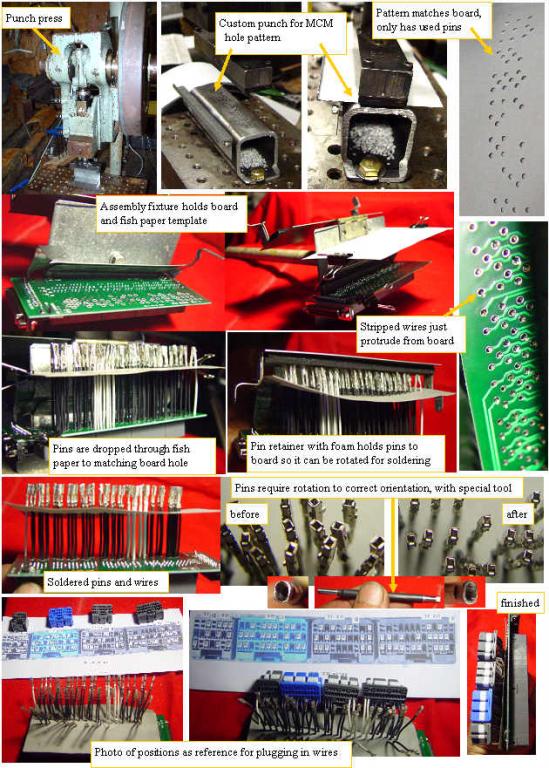
Getting the pins and wires in the correct position on the boards and connectors is of utmost importance. After a lot of careful analysis of the issues, I came up with a fixture that minimizes the possibility of miswiring, allows all pins to be double checked for position, holds the wires for soldering,and puts the required fishpaper insulation where required.
Using the board as a template, I made a punch for my punch press that punches out clearance holes into the fish paper, wherever there is a required wire. The fixture holds this paper template over the board so the wires can be passed through the fishpaper hole, then the board. Any miswiring shows up as the wire will not be parallel. Once all the pins are in place, a rubber covered clamp holds all the pins to the board, so the fixture can be rotated for soldering.
Once all the pins are soldered in place, a special tool is used to rotate the connectors into the correct orientation for insertion into the connector body.
A photo of the pin locations is used as a guide for the insertion process. A 100% continuity check will be performed on the completed sub assembly as a final test.


> Is it too late? I think not if we act now > Mikes Blogs > Building MIMA and the plug in adapters > Making the plug in boards
Home - Shopping Cart - New User Registration - MIMA Insight System - Projects - Workshops - Events - Resources - Mikes Blogs - Mikes Tips - What's New